Question road · 25 questions
History & Heritage Quiz: Questions and Answers
Five thousand years of history sit beside Irish roads: passage tombs older than the pyramids, round towers, Norman castles and the buildings where a modern state was born. These questions follow that long road.
Each question below shows the four options used in the game, then the right answer and a short fact. In Boreen the options are shuffled on every journey, and a right answer opens the next town gate.
Play these in the game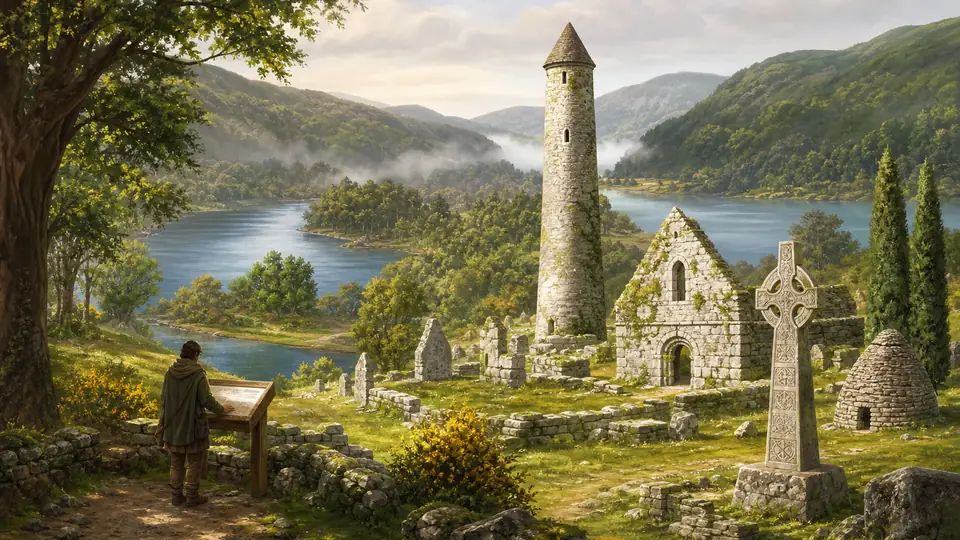
All 25 history & heritage questions
Roughly when was the Newgrange passage tomb built?
- About 3200 BC
- About 1200 BC
- About 500 BC
- About AD 500
Answer: About 3200 BC. Newgrange is about 5,200 years old — older than Stonehenge and the Great Pyramid of Giza.
Who is the patron saint of Ireland?
- St Brigid
- St Columba
- St Patrick
- St Kevin
Answer: St Patrick. St Patrick is the principal patron saint; Brigid and Columba are also patrons of Ireland.
On what date is St Patrick’s Day?
- 1 February
- 17 March
- 23 April
- 29 June
Answer: 17 March. St Patrick’s Day falls on 17 March, traditionally the date of his death.
Where is the Book of Kells kept?
- National Museum
- Trinity College Dublin
- Armagh Cathedral
- Kells Abbey
Answer: Trinity College Dublin. The 9th-century gospel book is on display in Trinity College’s Old Library.
In which year did the Easter Rising take place?
- 1798
- 1848
- 1916
- 1922
Answer: 1916. The Rising began in Dublin on Easter Monday, 24 April 1916.
In which year was the Battle of the Boyne fought?
- 1607
- 1649
- 1690
- 1798
Answer: 1690. William III defeated James II at the Boyne on 1 July 1690 (Old Style).
In which year did the Great Famine begin?
- 1798
- 1845
- 1867
- 1880
Answer: 1845. Potato blight first struck in 1845; the Famine lasted until about 1852.
In which century did the Vikings first settle at Dublin?
- 7th
- 9th
- 11th
- 13th
Answer: 9th. Vikings established a longphort at Dublin in 841.
In which year did Brian Boru fight the Battle of Clontarf?
- 795
- 1014
- 1169
- 1315
Answer: 1014. Brian Boru’s forces won at Clontarf in 1014, though the High King was killed.
In which year was the Irish Free State established?
- 1916
- 1919
- 1922
- 1937
Answer: 1922. The Irish Free State came into being on 6 December 1922.
Who was the first President of Ireland?
- Éamon de Valera
- Douglas Hyde
- Seán T. O’Kelly
- Michael Collins
Answer: Douglas Hyde. Douglas Hyde, founder of the Gaelic League, took office in 1938.
The Hill of Tara is traditionally the seat of whom?
- The High Kings of Ireland
- The Vikings
- The Normans
- The first bishops
Answer: The High Kings of Ireland. Tara was the ceremonial seat of the High Kings.
What were Ireland’s early medieval round towers mainly built as?
- Lighthouses
- Monastic bell towers
- Grain stores
- Prisons
Answer: Monastic bell towers. Round towers served as bell towers and lookouts beside monasteries.
What is Ogham?
- A type of harp
- An early alphabet cut into stones
- A Viking ship
- A hill fort
Answer: An early alphabet cut into stones. Ogham inscriptions use notches along the edge of standing stones.
In which year did Ireland join the European Economic Community?
- 1957
- 1973
- 1986
- 1992
Answer: 1973. Ireland joined the EEC on 1 January 1973, alongside the UK and Denmark.
In which year was the Good Friday Agreement signed?
- 1985
- 1994
- 1998
- 2005
Answer: 1998. The agreement was reached on 10 April 1998.
In whose reign did the Plantation of Ulster begin?
- Elizabeth I
- James I
- Charles I
- William III
Answer: James I. The Plantation of Ulster began in 1609 under James I.
Who was Gráinne Mhaol, also called Grace O’Malley?
- A Mayo sea captain and chieftain
- A Celtic goddess
- A Norman queen
- A 1916 leader
Answer: A Mayo sea captain and chieftain. Grace O’Malley commanded ships along the west coast and met Elizabeth I in 1593.
What is Skellig Michael famous for?
- A Norman castle
- An early monastery with beehive huts
- A Viking town
- A Famine village
Answer: An early monastery with beehive huts. Monks lived on the rocky island from about the 6th century; it is a UNESCO World Heritage Site.
In which Dublin prison were most leaders of the 1916 Rising executed?
- Mountjoy
- Kilmainham Gaol
- Arbour Hill
- Wheatfield
Answer: Kilmainham Gaol. Fourteen leaders were executed at Kilmainham Gaol in May 1916.
Daniel O’Connell was known by which title?
- The Chief
- The Liberator
- The Big Fellow
- The Uncrowned King
Answer: The Liberator. O’Connell won Catholic Emancipation in 1829, earning the name the Liberator.
Brú na Bóinne lies in the valley of which river?
- Shannon
- Barrow
- Boyne
- Suir
Answer: Boyne. Newgrange, Knowth and Dowth stand in a bend of the River Boyne.
What are the Céide Fields in County Mayo?
- A Neolithic field system
- A Viking battlefield
- A medieval monastery
- A Famine graveyard
Answer: A Neolithic field system. Stone walls preserved under the bog mark fields farmed nearly 6,000 years ago.
In which county was Michael Collins born?
- Kerry
- Cork
- Dublin
- Longford
Answer: Cork. Collins was born near Clonakilty in West Cork in 1890.
In which year did euro notes and coins replace the Irish pound?
- 1999
- 2002
- 2005
- 2008
Answer: 2002. Euro notes and coins went into circulation on 1 January 2002.