The Boreen Game Play Online
Seven questions. Seven town gates. Answer right and your walker strides along a country boreen, past whitewashed cottages and ash trees, and straight through the arch.
Eight question roads, 200 questions
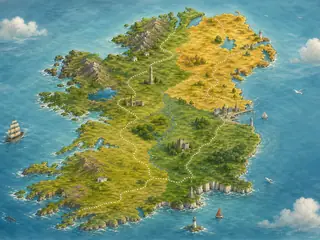
Every Boreen journey is drawn from eight roads of 25 questions each. Open any road to read all of its questions with their answers and the fact behind each one.
How a round works
One question stands at every gate
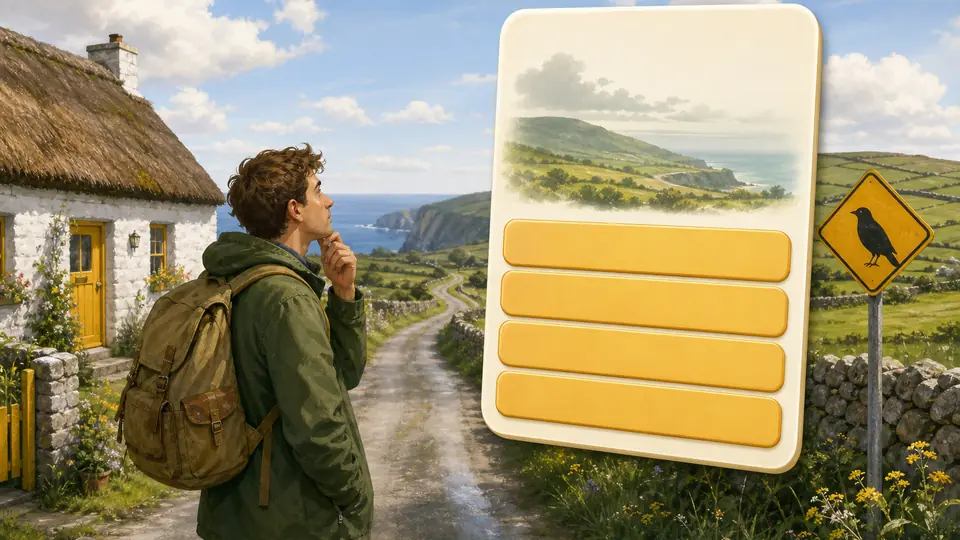
Your walker stops on the road and a question card appears: which county is the Burren in, what does cill mean in a place-name, who wrote Dracula? Four answers sit beneath it. Tap one, click one or press the number keys 1 to 4. You have 25 seconds, and the yellow bar along the bottom of the card shows the time running down.
The moment you answer, the card shows which answer was right. Then the question disappears and the road takes over: a right answer sends your walker into a run, a wrong answer slows them to a walk in front of a closed portcullis. Only after the walk does the result card appear, with the right answer, the distance and a short fact to remember.
Read the full how-to-play guide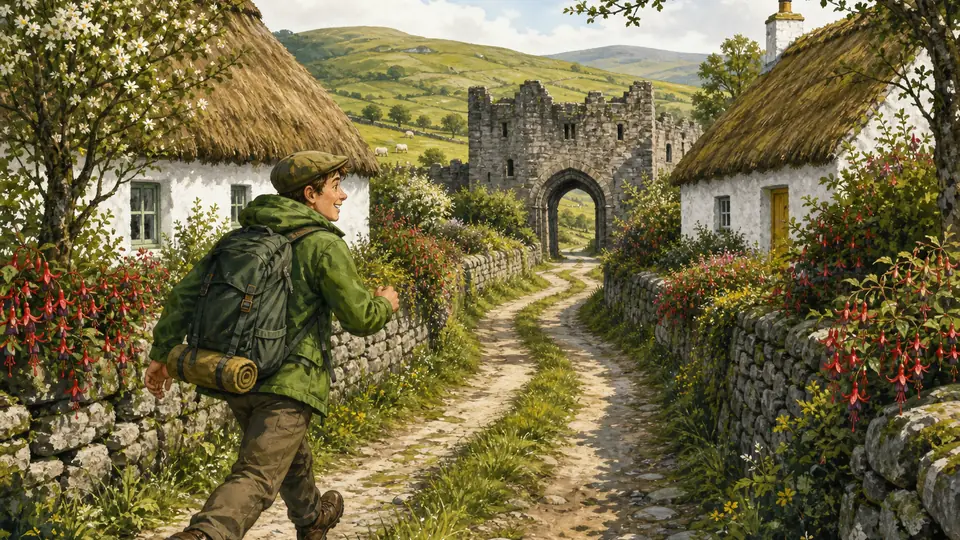
The road itself
Cottages, ash trees and dry-stone walls slide past
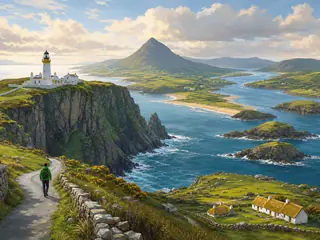
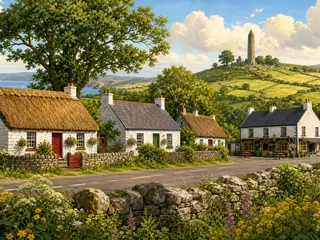
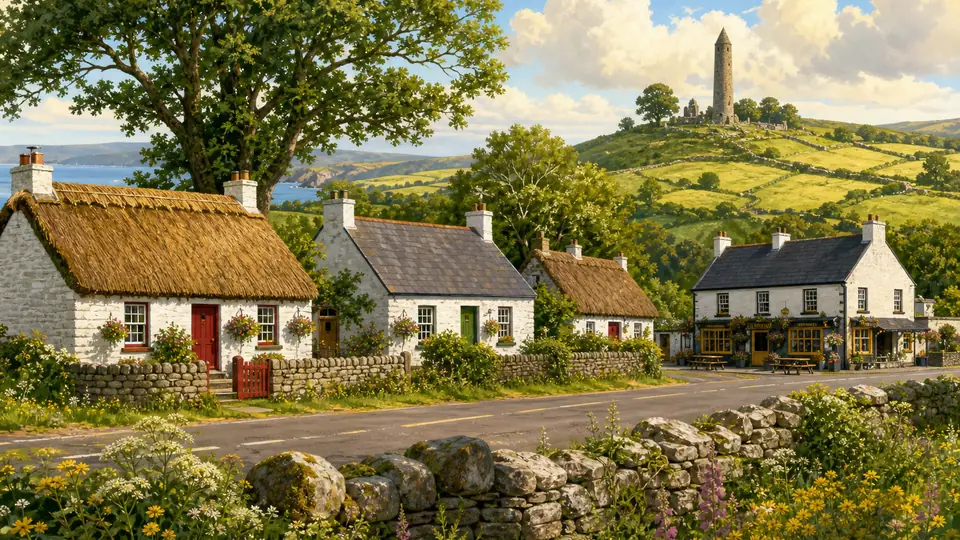
Boreen is drawn as a side-on country road, the kind you meet on the way to a holy well or a beach in the west. The scenery moves in layers. Far hills roll slowly with a round tower on the skyline; nearer fields carry hedgerows and grazing sheep; along the roadside come thatched cottages with red doors, a slate-roofed farmhouse, a pub with lit windows and stands of oak, ash and hawthorn. In front of it all runs a dry-stone wall topped with gorse and fuchsia.
The faster the walker moves, the faster those layers slide by, so a quick right answer feels like a sprint down the lane with the wind behind you. A wrong answer becomes an ordinary stroll that ends at a shut gate. The road never ends in failure: you always keep your distance, and the next question always comes.
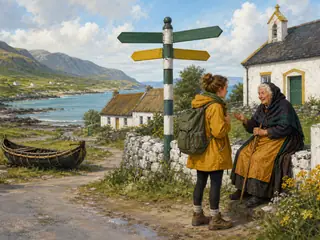
The road also explains the name. A boreen is narrower than a road and wider than a path, often with a strip of grass growing up the middle where no wheel ever touches. For many Irish people it is the road to a grandparent’s house, the bog or the shore, and that is the feeling the game tries to keep.
Real gates, real towns
Seven medieval town gates on every journey
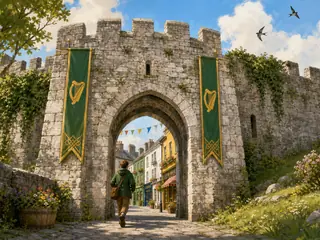
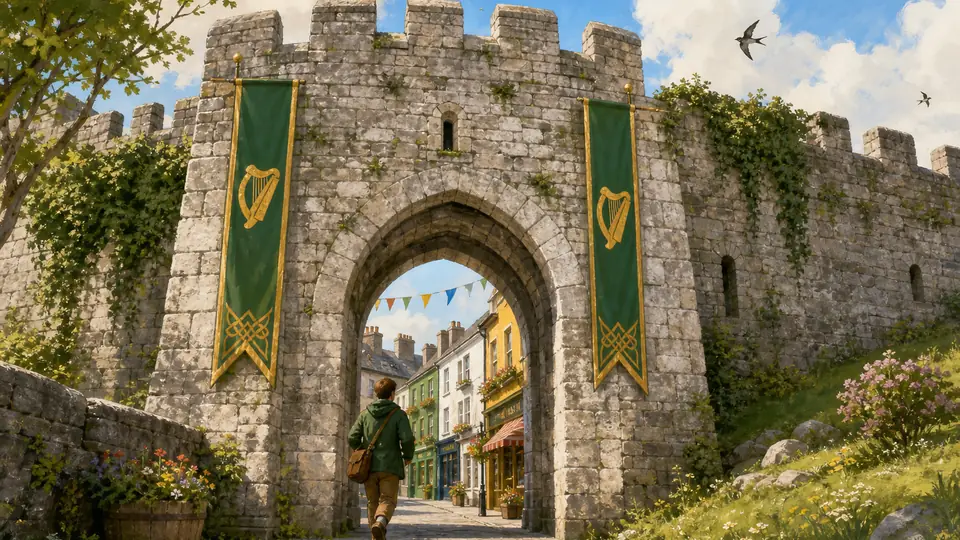
Irish towns were walled from Norman times into the 1600s, and a handful of their gates still stand. Each Boreen journey names its seven checkpoints after these surviving gates, and the final gate is always one of the two grandest: St Laurence’s Gate in Drogheda or Bishop’s Gate in Derry.
- Athenry North GateCounty Galway
The only surviving gate of the walled Norman town that gave its name to “The Fields of Athenry”.
- Fethard WatergateCounty Tipperary
Part of one of the most complete medieval town walls in Ireland, beside the Clashawley river.
- Clonmel West GateCounty Tipperary
A rebuilt gate arch that still marks the western edge of the old town on the Suir.
- Wexford WestgateCounty Wexford
The last survivor of the town’s Norse and Norman gates, now a heritage centre.
- Kilkenny Black Freren GateCounty Kilkenny
The only one of Kilkenny’s medieval gates still standing, beside the Black Abbey.
- Youghal Clock GateCounty Cork
A tall tower that straddles the main street of the walled seaside town.
- Carrickfergus North GateCounty Antrim
An Anglo-Norman gate that still lets traffic through the town walls.
- Derry Bishop’s GateCounty Derry
One of the original gates in the only complete city walls in Ireland.
- Drogheda St Laurence’s GateCounty Louth
A 13th-century barbican and the grand finish of many Boreen journeys.
Distance and scoring
A fast right answer walks you further
Boreen measures your journey in kilometres. A right answer is always worth at least 60 km and up to 100 km: the sooner you answer within the 25 seconds, the more of the 40 km speed bonus you keep. A wrong answer or an empty timer still moves you 10 km, so nobody finishes on zero.
| Outcome | Gate | Distance |
|---|---|---|
| Right, answered almost instantly | Opens | up to 100 km |
| Right, answered at the last second | Opens | 60 km |
| Wrong answer | Stays shut | 10 km |
| Out of time | Stays shut | 10 km |
Seven perfect, lightning-fast answers make 700 km — a little more than the drive from Mizen Head to Malin Head. The bar at the top of the game shows each gate as yellow when it opened and red when it stayed shut.
Bóithrín
What the word boreen means — and the clues hidden in Irish place-names
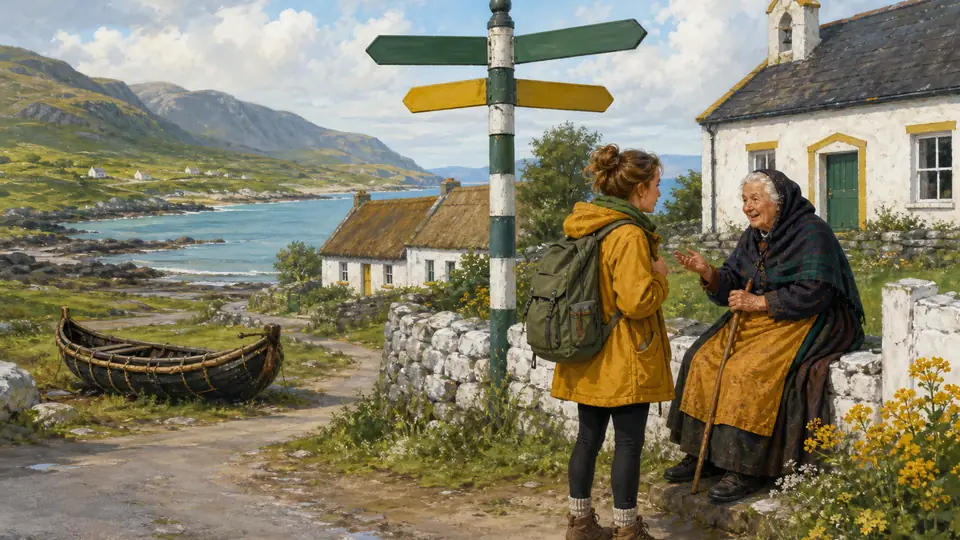
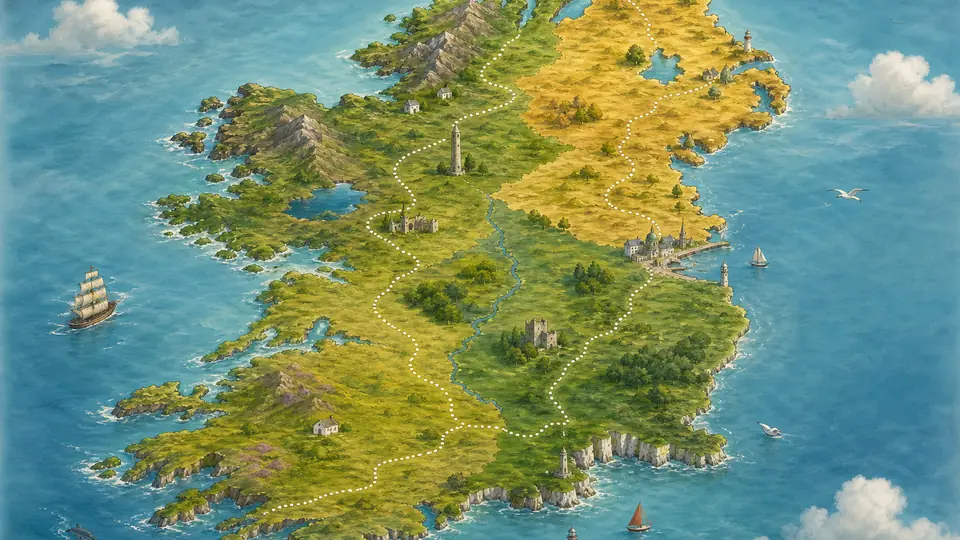
Boreen is the English spelling of the Irish bóithrín. Take bóthar, a road, add the small ending -ín, and you have a little road. The same ending turns cailín into a girl and páistín into a little child.
Once you know a few Irish words, the map of Ireland starts to explain itself. Most townland and town names were translated or spelled out from Irish, so the same elements turn up again and again. The Irish Language road in Boreen asks about them, and they are some of the most useful facts a visitor can learn.
- Baile / Bally
- town, townland — Ballina, Ballymena
- Cill / Kil
- church — Kilkenny, Killarney
- Dún / Dun
- fort — Dundalk, Dún Laoghaire
- Áth / Ath
- ford — Athlone, Athy
- Cnoc / Knock
- hill — Knock, Knocknarea
- Inis / Inish
- island — Inishowen, Inis Mór
The question bank
200 questions you can actually answer
Boreen’s questions are written for people who have lived in, visited or simply love Ireland. They aim at the knowledge that comes up in conversation — county nicknames, the longest river, what sláinte means — rather than obscure dates. Every question has four answers, and the wrong ones are plausible enough to make you think.
Here are three from the bank, with their answers:
- Which county is known as “the Banner County”? Clare.
- What does the name Dublin, Dubh Linn, mean? Black pool.
- St Laurence’s Gate stands in which town? Drogheda.
Each day the bank is shuffled, and your browser steps through it seven questions at a time, so you can walk 28 journeys before any question comes round again.
Browse all 200 questionsMore than maps
Music, sport, stories and the kitchen table
Geography is only half of Boreen. The other half is the culture that grew along those roads, and four of the eight question roads are about it.
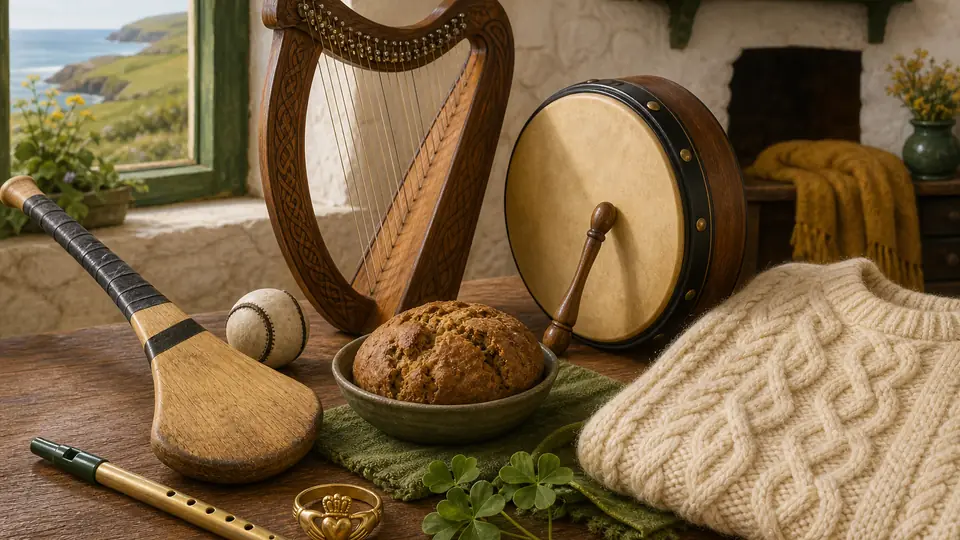
Music, literature and arts
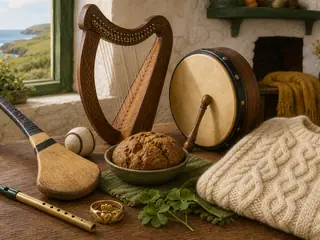
From Joyce’s Ulysses and Bloomsday to the bodhrán, the uilleann pipes and Ireland’s record seven Eurovision wins.
25 arts questionsSport and Gaelic games
The GAA’s founding in Thurles, the Liam MacCarthy and Sam Maguire cups, road bowling and the Galway Races.
25 sport questions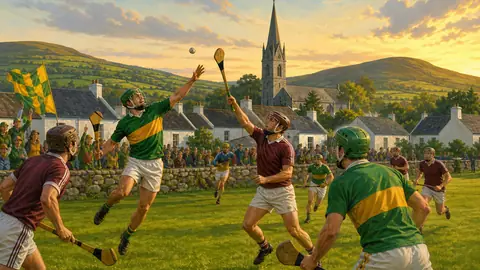
Customs, food and folklore
Samhain and Halloween, Brigid’s crosses, the banshee, colcannon and barmbrack, and the 9,000-year lease at St James’s Gate.
25 folklore questionsHistory and heritage
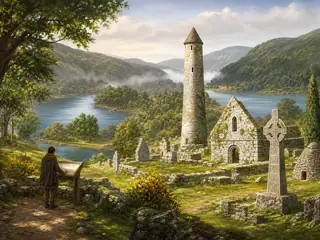
Newgrange, round towers, Brian Boru, 1916 and the Good Friday Agreement — five thousand years beside the road.
25 history questions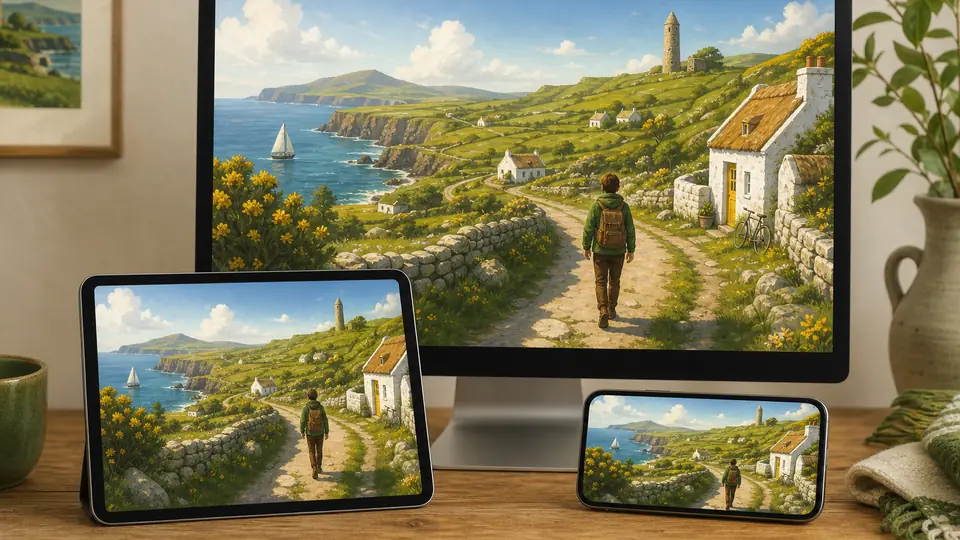
Play anywhere
Made for the phone in your pocket and the laptop on the table
On a phone, the road fills the top of the screen and the four answers stack beneath your thumb. On a desktop, the question card sits beside the road and the number keys 1 to 4 answer instantly. The Fullscreen button above the game gives the walk the whole screen, which suits a tablet passed around the kitchen on a quiz night.
There is nothing to install and no account to create. Your browser keeps a small note of how far through today’s shuffle you are, so the next journey starts with new questions. Boreen does not send your answers anywhere: the whole game runs on your own device.
Before you set off
Boreen FAQ
What is Boreen?
Boreen is a free browser quiz about the geography and culture of Ireland. Each journey asks seven multiple-choice questions, and every right answer walks you along a country road and through a medieval town gate.
What does the word boreen mean?
Boreen comes from the Irish bóithrín, a little road. It is bóthar, road, with the diminutive ending -ín, and it still describes the narrow grassy lanes found all over rural Ireland.
How many questions are there?
The question bank holds 200 questions across eight roads: counties, landscape, towns, history, the Irish language, the arts, sport and folklore. Each journey draws seven of them.
How is the distance worked out?
A right answer is worth between 60 and 100 km: the faster you answer within the 25 seconds, the further you walk. A wrong answer or a timeout keeps you moving 10 km, but the gate stays shut.
Do I need an account?
No. Boreen runs in your browser without sign-up. A small note in your browser remembers which questions you have already walked today so the next journey starts fresh.
Can I study the answers?
Yes. Every question, with its correct answer and a short fact, is published on the question pages, grouped by road. Reading them is a good way to prepare for a quiz night.