Every question in Boreen is printed here with its right answer and the fact that explains it. They cover the whole island — its 32 counties, rivers and mountains, towns and town gates, five thousand years of history, the Irish words hidden in place-names, writers and musicians, Gaelic games and the customs of the countryside.
Use them to prepare for a pub quiz, plan a road trip, set a class quiz, or check the answer that kept a gate shut. Then walk a journey and see how many you remember when the clock is running.
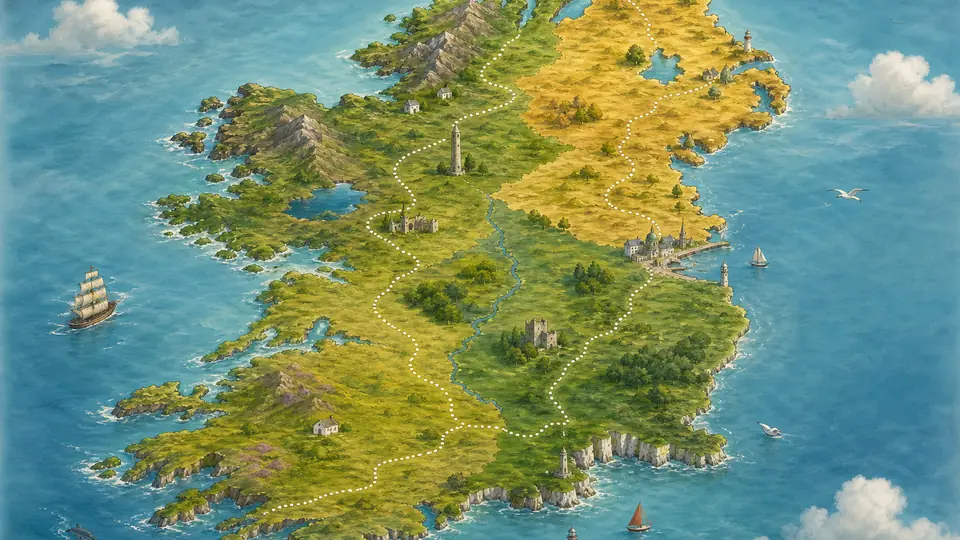
Eight question roads cover the island. Illustrative map, not to scale.
Ireland’s 32 counties and four provinces are the first map most people learn. County nicknames, provincial borders and the places that make each county famous turn up in every pub quiz, every GAA conversation and every road trip across the island.
How many counties are there on the island of Ireland? 32. There are 32 counties: 26 in the Republic of Ireland and 6 in Northern Ireland.
How many traditional provinces does Ireland have? Four. The four provinces are Leinster, Munster, Connacht and Ulster.
Which province contains Cork, Kerry and Waterford? Munster. Munster has six counties: Clare, Cork, Kerry, Limerick, Tipperary and Waterford.
Which is the largest county in Ireland by area? Cork. County Cork covers about 7,500 km², the largest of the 32 counties.
Which is the smallest county in Ireland by area? Louth. Louth, known as “the Wee County”, covers roughly 820 km².
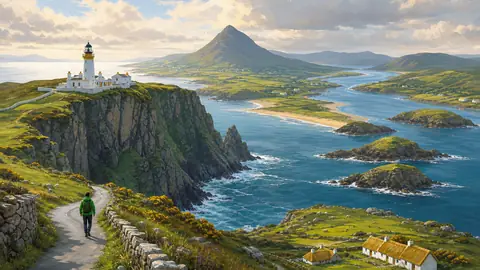
Rivers, loughs, mountains, islands and Atlantic cliffs shape where Irish roads run and where towns grew. These questions travel from Malin Head to Mizen Head and from the Shannon to the Skelligs.
What is the longest river in Ireland? Shannon. The Shannon runs for about 360 km, the longest river in Ireland and Britain.
What is the highest mountain in Ireland? Carrauntoohil. Carrauntoohil in Kerry’s MacGillycuddy’s Reeks reaches 1,038 m.
What is the largest lake in Ireland? Lough Neagh. Lough Neagh covers about 390 km², the largest lake in Ireland and Britain.
Croagh Patrick overlooks which bay? Clew Bay. Croagh Patrick rises above Clew Bay, famous for its scattering of drumlin islands.
The Aran Islands lie at the mouth of which bay? Galway Bay. Inis Mór, Inis Meáin and Inis Oírr guard the mouth of Galway Bay.
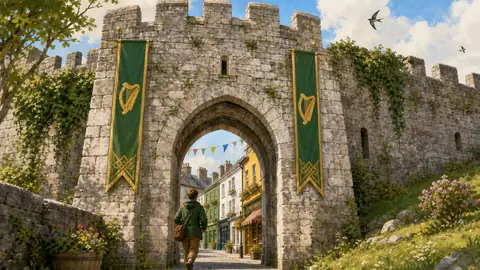
Every boreen eventually leads to a town. Walled cities, market towns, ports and festival towns each carry nicknames and landmarks that locals love to quiz visitors about — including the medieval gates the Boreen walker passes through.
What is the capital of Northern Ireland? Belfast. Belfast became the capital of Northern Ireland in 1921.
What is the second-largest city in the Republic of Ireland? Cork. Cork is the Republic’s second city after Dublin.
Which city is known as “the City of the Tribes”? Galway. Galway’s nickname comes from the fourteen merchant families who ruled the medieval town.
Which city is known as “the Marble City”? Kilkenny. Kilkenny’s streets were once paved with local black limestone known as Kilkenny marble.
Which city is traditionally called Ireland’s oldest city, founded by Vikings in 914? Waterford. Waterford was founded as a Viking settlement in 914.
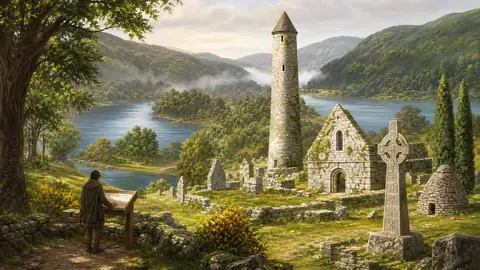
Five thousand years of history sit beside Irish roads: passage tombs older than the pyramids, round towers, Norman castles and the buildings where a modern state was born. These questions follow that long road.
Roughly when was the Newgrange passage tomb built? About 3200 BC. Newgrange is about 5,200 years old — older than Stonehenge and the Great Pyramid of Giza.
Who is the patron saint of Ireland? St Patrick. St Patrick is the principal patron saint; Brigid and Columba are also patrons of Ireland.
On what date is St Patrick’s Day? 17 March. St Patrick’s Day falls on 17 March, traditionally the date of his death.
Where is the Book of Kells kept? Trinity College Dublin. The 9th-century gospel book is on display in Trinity College’s Old Library.
In which year did the Easter Rising take place? 1916. The Rising began in Dublin on Easter Monday, 24 April 1916.
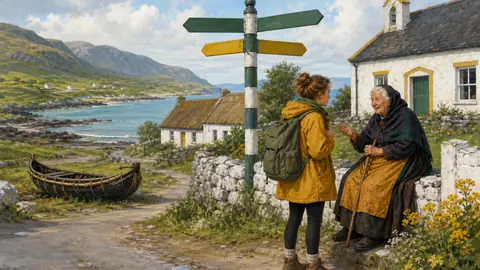
Boreen itself is an Irish word: bóithrín, a little road. Thousands of place-names hide Irish words for forts, churches, fords and hills, and a handful of everyday phrases will take a traveller a long way.
The word “boreen” comes from the Irish bóithrín. What does it mean? A small road or lane. Bóithrín is bóthar (road) with the diminutive -ín: a little road.
What is the Irish word for road? Bóthar. Bóthar means road; the smaller bóithrín became the English “boreen”.
In bóithrín, what does the ending -ín add to the meaning? It makes it small. The suffix -ín is a diminutive, as in cailín (girl) and bóithrín (little road).
In Irish place-names, what does “Dún” or “Dun” usually mean? Fort. Dún means a fort, as in Dún Laoghaire and Dundalk.
What does “Cill” or “Kil” usually mean in a place-name? Church. Cill means church, as in Kilkenny (Cill Chainnigh, Canice’s church).
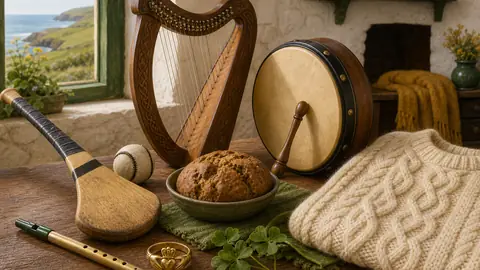
A small island with four Nobel Prizes for Literature, a harp on its coins and a session in every second pub. These questions cover writers, songs, instruments and the stage.
Which musical instrument is Ireland’s national emblem? Harp. The harp appears on Irish coins, passports and the presidential seal.
Who wrote the novel Ulysses? James Joyce. James Joyce’s Ulysses, published in 1922, follows one Dublin day.
On what date is Bloomsday celebrated? 16 June. Bloomsday marks 16 June 1904, the day on which Ulysses is set.
In which year did W.B. Yeats win the Nobel Prize in Literature? 1923. Yeats was the first Irish writer to win the Nobel Prize in Literature, in 1923.
Who wrote Dracula? Bram Stoker. Bram Stoker, born in Clontarf in 1847, published Dracula in 1897.
Hurling, Gaelic football, camogie and handball are played in every parish, and Croke Park fills for September Sundays. Add rugby, racing, boxing and golf, and sport becomes one of the easiest ways into Irish conversation.
In which year was the Gaelic Athletic Association founded? 1884. The GAA was founded on 1 November 1884.
In which town was the GAA founded? Thurles. The founding meeting took place in Hayes’ Hotel, Thurles, County Tipperary.
What is the ball used in hurling called? Sliotar. The sliotar is a leather ball with raised stitching; the stick is the hurley or camán.
What is the women’s version of hurling called? Camogie. Camogie has been organised since 1904.
How many players are on a Gaelic football team on the field? 15. Gaelic football and hurling teams both field fifteen players.
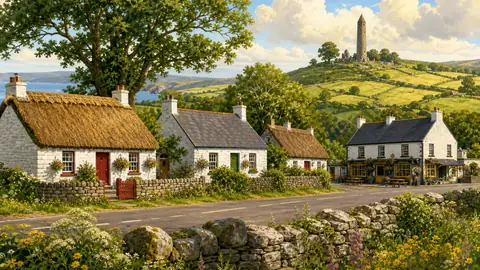
Fairy forts beside the road, Brigid’s crosses over the door, barmbrack at Halloween and soda bread on the table: the customs of the countryside are where geography turns into culture.
Halloween grew out of which Celtic festival? Samhain. Samhain marked the end of the harvest and the start of winter.
On which day are St Brigid’s crosses traditionally made from rushes? 1 February. St Brigid’s Day, 1 February, coincides with Imbolc, the start of spring.
In folklore, what does the cry of the banshee foretell? A death in the family. The bean sí, or fairy woman, keens before a death.
What trade is the leprechaun traditionally said to practise? Shoemaker. The leprechaun is a solitary fairy shoemaker with a hidden crock of gold.
What is colcannon? Mashed potato with cabbage or kale. Colcannon is a traditional Halloween dish of potato and greens.
Facts are checked against public reference sources.
How the questions are written
Each question has exactly one right answer and three plausible wrong ones. The wrong answers are real places, people and dates, chosen so that a guess still needs some knowledge: the Shannon sits beside the Liffey and the Boyne, Cork beside Galway and Donegal. Numbers are rounded where sources differ, and the fact under each answer explains the detail so the right answer is easy to remember next time.
The questions favour knowledge that turns up in everyday Irish conversation and travel over trick questions. County nicknames, river cities, the meaning of place-name elements, the Book of Kells, the Liam MacCarthy Cup and barmbrack at Halloween are all things a curious visitor would meet within a week on the road. Sources and the correction process are described on the sources page.
If you believe an answer is wrong or out of date, send the question and a reliable source to [email protected].
Using the bank for a quiz night or a classroom
The eight roads work well as eight rounds of 25. For a shorter evening, take five questions from each road for a forty-question quiz, read the four options aloud, and give a bonus point for anyone who can explain the fact. In a classroom, the Counties, Landscape and Language roads pair naturally with a map of Ireland: pupils can pin each answer to its county as the quiz goes on.
The Irish Language road is a gentle introduction to place-names. Once a group knows baile, cill, dún, áth and inis, they can decode hundreds of signposts. The History road runs in rough time order from Newgrange to the euro if you read it from the top.